Student Database Management: One Student, One Record
Student information is more than a collection of admission forms and academic records. Discover how modern student database management helps Indian schools create a unified, secure and continuously updated information ecosystem that connects student identities, attendance, academics and campus operations. With SSMS, schools can move beyond fragmented records towards smarter, more connected institutional management.
By SSMS Team
Introduction: Every Student Has a Journey. Does Their Data Keep Up?
A student joins a school in Class 1. Over the years, their class changes, academic performance evolves, parents update their contact details, new documents are added, health information gets revised and eventually, the student may transfer to another branch or leave the institution.
The student moves forward. But what happens to their information?
In many schools, the answer is surprisingly complicated. One department maintains admission details, another updates attendance, the accounts team manages fee records, and teachers maintain academic information through separate files or applications. When the institution needs a complete student history, someone has to bring all these records together manually.
This is not simply an administrative inconvenience. It is a fundamental information management problem.
Student database management needs to evolve beyond maintaining digital copies of physical registers. It must establish a reliable, continuous and interconnected identity for every student, allowing authorised departments to work with accurate information without repeatedly collecting or updating the same details.
For Indian schools dealing with changing academic sessions, multiple education boards, UDISE+, APAAR requirements, transfers and growing enrolments, this transformation is particularly important.
The real question is no longer how much student information a school can store. It is how intelligently that information can be maintained, connected, protected and used throughout a student's educational journey.
1. The Problem Is Not Missing Data. It Is Disconnected Data.
Most educational institutions already possess substantial amounts of student information. The difficulty lies in maintaining consistency across departments.
Consider a simple situation.
A parent changes their mobile number and informs the school office. The admission register gets updated, but the class teacher's contact sheet remains unchanged. The accounts department continues using the previous number, while the transport team has another version of the information.
Now, an important attendance notification or transport alert may reach the wrong contact.
This is what happens when institutions maintain multiple versions of the same student record.
Effective student database management begins by eliminating this fragmentation through a centralised information structure.
Instead of creating separate student entries for different departments, a school needs one permanent student identity connected to the relevant institutional functions.
This approach offers several advantages:
Reduces repetitive data entry across departments.
Minimises inconsistencies in personal and academic information.
Makes student history easier to retrieve.
Improves coordination between administrative and academic teams.
Creates a more dependable foundation for reporting and documentation.
A modern school management system should therefore be evaluated not simply by its ability to store records, but by how effectively it maintains one consistent source of student information.
2. One Student, One Identity: The Foundation of Intelligent Records
The most important architectural decision in a modern student information environment is the distinction between a person and their enrolment.
A student's identity remains the same even when their academic circumstances change.
Their admission number may change. Their class, section, roll number or campus may change. They may leave the school and return after a few years. None of these events should require the institution to create an entirely disconnected identity.
This is the principle behind person-centric student database management.
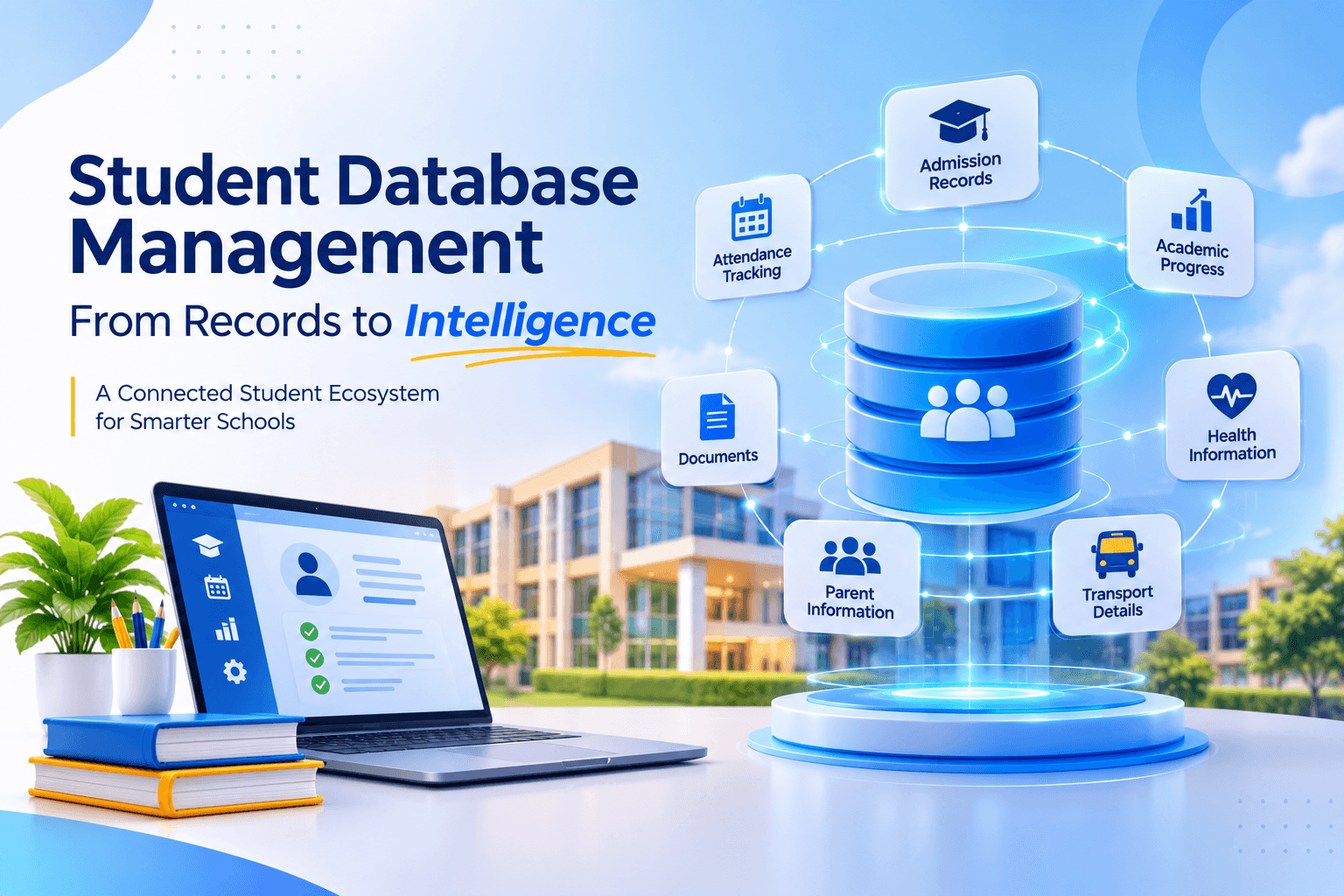
A well-structured record should connect:
Personal identity: Name, photograph, date of birth, address, local-script name and identification details.
Family relationships: Parents, guardians, emergency contacts and siblings, including relationships across different branches of a school group.
Admission history: Admission date, previous school, admission category, enrolment details and session-wise records.
Academic progression: Class, section, roll number, examination history and promotion details.
Supporting documents: Birth certificates, previous report cards, identification documents, transfer certificates and other required records.
Student welfare: Relevant health information, allergies, medical conditions and authorised emergency information.
The important part is that these records should remain connected without becoming one unrestricted collection of personal information.
SSMS follows this person-centric approach through its Student Information System. It maintains one permanent record for each child, connecting family details, documents, enrolment history, transfers, re-admission and promotion.
This makes student database management more sustainable because institutional changes update the student's journey rather than erase their history.
3. The Indian School Challenge: Managing Records Beyond the Admission Register
Indian schools operate within a diverse administrative and educational environment. Different boards, regional languages, academic structures and government reporting requirements influence how student information must be maintained.
A database that works for a small single-campus institution may require additional capabilities when implemented across a school group or a large residential campus.
Three areas deserve particular attention.
UDISE+ and APAAR readiness
Schools need accurate student information for various reporting and identification requirements.
UDISE+ collects school-level information, including student and teacher details, while APAAR provides a framework for creating a unified academic identity for students.
Missing fields, inconsistent spellings, incomplete documents and outdated information can complicate institutional reporting.
A capable student database management solution should help schools organise the required information, identify missing entries and prepare relevant data for submission.
SSMS includes UDISE+, APAAR and CBSE-related workflows, including consent recording, data checks and downloadable reporting files.
Multilingual student information
Names, addresses and family details are not always represented consistently across languages.
For schools serving communities with different linguistic backgrounds, the ability to maintain names in local scripts and communicate with parents in their preferred languages can improve record accuracy and accessibility.
Multi-branch student continuity
When a student moves between branches of the same school group, their institutional history should remain accessible to authorised stakeholders.
A centralised student management system can preserve the original enrolment history while creating the appropriate new enrolment at the receiving branch.
This becomes particularly valuable for educational trusts and institutions operating multiple campuses.
4. The Hidden Value of Student Data: Connecting Attendance, Academics and Administration
A student's database should not remain a static profile that is updated only when the office needs a document.
Its real value increases when relevant information connects with the school's everyday operations.
For example, attendance is not merely a daily count. It is a continuous record of participation.
When a school uses a separate student attendance management system, attendance information should ideally connect with the student's permanent profile rather than remain isolated in another register.
Similarly, an effective student attendance system should support the institution's actual attendance practices, whether daily, twice-daily or period-wise.
With appropriate integration, authorised users can examine:
Student attendance and leave history.
Class and section changes.
Examination participation and academic results.
Parent and guardian contact information.
Relevant health and welfare alerts.
Fee and administrative records.
This creates a more useful institutional information environment.
Consider a student who has been absent repeatedly. The class teacher needs the attendance history, the office needs the parent's current contact information, and the school may need to review an existing leave application.
When these records are connected, the institution can respond with better context and less administrative effort.
SSMS supports daily, twice-daily and period-wise attendance, RFID and biometric punches, leave applications, parent alerts and audited attendance corrections.
Its connected records also make student attendance tracking more meaningful because attendance information belongs to the student's wider institutional history.
5. Data Migration: Why Moving to a New System Should Not Mean Starting Again
One of the biggest concerns schools face while adopting new technology is the fate of their existing information.
Years of records may be stored in Excel files, legacy applications, admission registers and departmental spreadsheets. Re-entering everything manually is expensive, time-consuming and vulnerable to errors.
This is why migration deserves as much attention as the new software itself.
A reliable migration process should involve four stages.
Stage 1: Data discovery
Identify existing student records, duplicate entries, incomplete fields, outdated contact information and inconsistent formats.
Stage 2: Data validation
Check required fields, verify identification details and identify conflicting information before importing it.
Stage 3: Controlled migration
Import records in a structured process that allows the institution to review the data before it becomes part of the live database.
Stage 4: Post-migration verification
Check student counts, class allocations, family relationships, documents and important historical information.
SSMS provides bulk Excel import with row-level validation, duplicate detection, a preview before confirmation and downloadable error reports.
This is an important advantage for institutions moving from manual registers or another software platform.
Good student database management should preserve institutional knowledge during technology adoption, not force schools to rebuild it.
6. Student Records Must Be Protected, Not Merely Stored
A student database contains considerably more than names and admission numbers. It may include family contact details, identification documents, health information and other sensitive personal information.
Consequently, accessibility and security must develop together.
Not every employee needs access to every record. A class teacher may need attendance and relevant student information, while the accounts department requires financial records. Health information should be restricted to appropriately authorised roles.
A responsible student database management architecture should incorporate:
Role-based access permissions.
Masking of sensitive identification details.
Controlled document access and exports.
Audit trails for sensitive information access.
Appropriate security safeguards and backups.
Clear procedures for handling personal information.
India's Digital Personal Data Protection Act, 2023 and the DPDP Rules, 2025 make responsible personal data processing especially important for organisations handling children's information.
Schools and their technology providers must consider applicable consent requirements, lawful processing, security safeguards and responsibilities for protecting children's data.
SSMS supports role-based permissions, masking of sensitive identifiers and access logging. Its student health information can also be restricted to designated roles.
Importantly, technology should make information available to the right people, not automatically available to everyone.
7. Beyond Student Records: The Rise of Campus-Wide Data Connectivity
A school does not operate through the admission office alone. It functions through interconnected departments that continuously generate information about students, employees, resources and campus activities.
This is where campus automation becomes an important part of the discussion.
Imagine a school where admission confirmation creates the student record, the appropriate fee structure is assigned, the student appears in the relevant class list, and the parent receives access to the school portal.
Later, attendance updates generate parent notifications, examination results become available through authorised channels, and promotion workflows prepare the next academic session.
This is not a collection of independent digital activities. It is a connected institutional workflow.
A broader campus management CRM and administrative ecosystem can extend this connectivity to transport, hostel management, library operations, health services, visitor management and parent communication.
The objective is to ensure that information collected by one department can support another department when there is a legitimate operational need.
A comprehensive ERP for school should provide this foundation while maintaining appropriate access restrictions and clear responsibility for data updates.
For institutions evaluating a school ERP, this level of connectivity is a more meaningful measure of technological maturity than the number of standalone features available.
8. SSMS: From a Student Information System to a Unified School Ecosystem
Student information becomes significantly more valuable when the institution does not have to manage it through disconnected applications.
SSMS (Smart School Management Suite) approaches this requirement through a unified platform that connects student records with admissions, attendance, academics, examinations, fees, communication and campus operations.
Its Student Information System provides a permanent student identity with connected parent and sibling relationships, document management, enrolment history, transfers, transfer certificates, re-admission and promotion.
The platform also supports practical requirements such as:
Bulk student migration from Excel.
Identification and duplicate checks.
Document verification and tracking.
Session-wise academic progression.
Provisional and confirmed promotion.
Transfer history across school branches.
Restricted access to sensitive health information.
Search using student names, admission numbers, parent mobile numbers and roll numbers.
The wider platform connects these records with attendance, UDISE+, APAAR, examinations, fee management, parent portals, transport and other institutional operations.
This makes SSMS more than a standalone student management portal. It provides the foundation for a connected school-wide information ecosystem.
For institutions searching for the best school ERP in India, the distinction matters. The right platform should not simply digitise existing registers. It should improve how information moves across the institution.
SSMS is designed around this principle, bringing the capabilities of a modern ERP for Indian schools into one configurable environment.
9. The Future of Student Database Management Is Continuity
The next generation of educational technology will be defined by how effectively institutions preserve and use information over time.
A student's educational journey should not become a collection of disconnected entries. Every admission, academic progression, attendance record, transfer and important institutional update should contribute to a reliable history.
That is the real purpose of student database management.
When student information is accurate, connected and appropriately protected, schools spend less time reconciling records and more time supporting the people behind them.
Administrators gain better operational visibility. Teachers access relevant information without searching through multiple files. Parents receive more consistent communication. School leaders gain a dependable foundation for institutional planning.
The objective is not to collect more data. It is to make existing information more useful, reliable and meaningful.
SSMS brings this vision into practice by connecting permanent student records with the academic, administrative and operational functions of an educational institution.
Because every student deserves more than a record that gets updated once a year. They deserve an institutional system that remembers their journey.
Explore SSMS and discover a smarter approach to managing your school's student information.