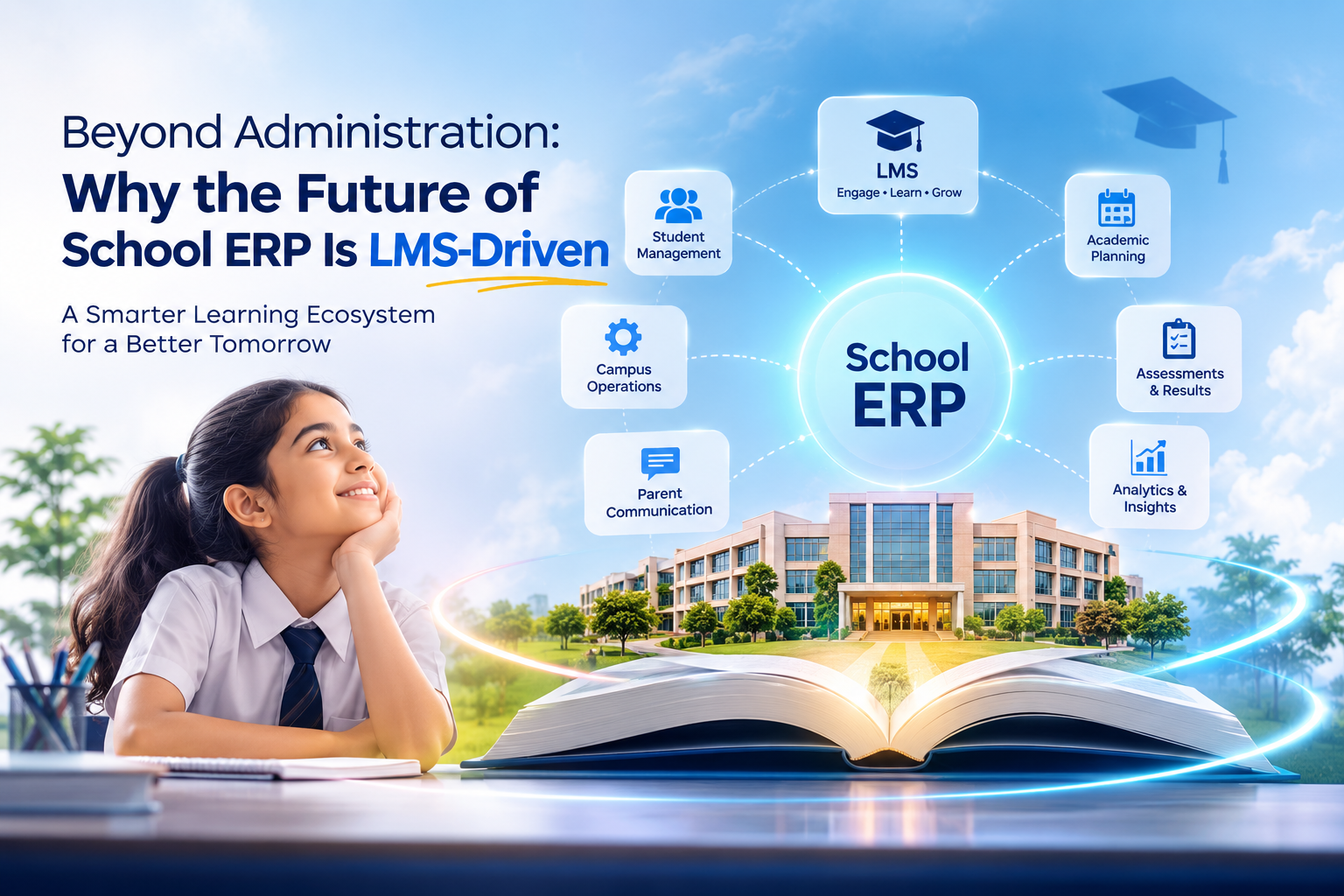
إلى ما بعد الإدارة: لماذا مستقبل نظام إدارة المدارس ERP يعتمد على نظام إدارة التعلم LMS
اكتشف كيف يتطور مستقبل نظام إدارة المدارس ERP إلى ما بعد الإدارة التقليدية من خلال التعلم المدعوم بنظام LMS، والعمليات الأكاديمية المتكاملة، وبيانات الطلاب الذكية، وإدارة الحرم المدرسي الموحدة. استكشف كيف يمكن تكنولوجيا التعليم المتكاملة مساعدة المدارس في بناء منظومات أكثر ذكاءً وكفاءة وتمركزاً حول المتعلم.
بواسطة SSMS Team
متوفر أيضاً بـ:Englishहिन्दीગુજરાતીमराठीਪੰਜਾਬੀবাংলাଓଡ଼ିଆதமிழ்తెలుగుಕನ್ನಡമലയാളംاردوঅসমীয়াनेपालीसंस्कृतम्कोंकणीमैथिलीडोगरीسنڌيکٲشُرFrançaisEspañolDeutschPortuguêsItalianoNederlandsРусскийTürkçeفارسیKiswahiliBahasa IndonesiaBahasa MelayuไทยTiếng Việtසිංහල简体中文日本語한국어
Introduction
Education has never been short of technology. Schools have adopted digital attendance systems, online fee collection, virtual classrooms, examination portals and communication applications. Yet, a fundamental problem continues to exist: most of these technologies operate independently.
A teacher may maintain academic progress in one application, an administrator may manage student records in another, and the examination department may depend on spreadsheets to evaluate performance. Each system performs its designated function, but the information rarely travels seamlessly between them.
This is where the next generation of school ERP needs a different direction.
The real opportunity is no longer limited to automating institutional administration. It lies in connecting the academic experience with the operational intelligence of an educational institution. The growing relevance of Learning Management Systems (LMS), particularly in higher education, offers an important perspective on how this transformation can happen.
Universities increasingly require digital environments that connect course delivery, assessments, faculty engagement, student participation and academic progress. Schools can benefit from the same underlying philosophy, adapted to their teaching structures, age groups and institutional requirements.
The future belongs to an integrated education ecosystem where learning and management are not separate conversations.
1. The Higher Education LMS Revolution Has a Lesson for Schools
Higher education has experienced a significant shift in how learning is organised. An LMS is no longer simply a place to upload lecture notes or distribute assignments. It can function as a structured academic environment where courses, learning resources, assessments, faculty interactions and student participation come together.
Consider a university student enrolled in multiple subjects. Their academic experience involves course schedules, reading materials, assignments, examination dates, feedback and performance records. When these elements operate in isolation, students and faculty spend unnecessary time navigating systems instead of concentrating on education.
An interconnected learning environment changes this relationship.
The same principle applies to schools, although the implementation must be age-appropriate. A school needs to connect its curriculum, lesson planning, attendance, assessment patterns, teacher responsibilities and student progress.
A modern school ERP should therefore be viewed as the institutional foundation upon which a connected learning experience can develop.
The distinction is important. An LMS manages the learning journey, while an ERP coordinates the institution that makes that journey possible. When these environments communicate effectively, schools gain a more complete understanding of what is happening inside and outside the classroom.
2. From Learning Management to Learning Intelligence
The next stage of educational technology is not simply about making learning digital. It is about making academic information meaningful.
A conventional digital platform might record whether a student attended a class, submitted an assignment or appeared for an examination. A more connected ecosystem asks what these activities reveal about the student's academic journey.
For example, consider a student whose attendance has gradually declined and whose assessment scores have also started falling.
If attendance records and examination data exist in separate systems, identifying this pattern requires manual investigation. When academic information is connected, teachers and authorised administrators can examine the available indicators together and decide whether the student needs additional attention.
This does not mean software should independently judge a learner or replace a teacher's understanding. It means technology should make relevant information easier to access when human intervention matters.
A thoughtfully implemented school ERP can support this transition through connected student records, academic tracking, examination management and reporting.
The larger vision is to move from record-keeping towards informed academic intervention.
3. Why LMS and ERP Should Not Operate as Competing Technologies
One common misconception in educational digitisation is that institutions must choose between an LMS and an ERP.
In reality, the two serve complementary purposes.
Learning Management System | Enterprise Resource Planning |
|---|---|
Organises learning resources | Coordinates institutional operations |
Supports course and lesson delivery | Manages academic schedules |
Facilitates assignments and learning activities | Maintains student and staff records |
Supports assessments and feedback | Coordinates examinations and results |
Provides learning engagement information | Connects information across departments |
The real value emerges when the two environments can exchange relevant information securely.
For instance, class and subject information maintained by the institutional system can support accurate academic access. Assessment information can contribute to a broader student progress record. Timetable changes can inform teachers and students without repeated manual updates.
This is why schools evaluating a school management system should look beyond the number of available modules. They should examine whether the underlying architecture allows information to flow between academic and administrative functions.
An effective school management software solution should reduce duplication, improve data consistency and make institutional information useful to the people who need it.
The OECD's research on digital education ecosystems also highlights interoperability as an important condition for making information from different educational technologies more useful.
4. The Academic Data Pipeline: Connecting Every Stage of Learning
Perhaps the most important shift is to stop viewing academic activities as isolated events.
A student's learning journey generates information continuously. Curriculum planning establishes what should be taught. Timetables determine when and by whom it is delivered. Attendance provides participation information. Assessments reveal performance. Feedback helps identify areas requiring improvement.
A connected academic information pipeline brings these elements into context.
Curriculum and lesson tracking
Academic planning should extend beyond preparing an annual syllabus. Schools need visibility into chapter completion, learning outcomes, subject coverage and teaching progress.
SSMS supports curriculum and syllabus planning at unit, chapter and topic levels, with learning outcome mapping and teaching progress tracking.
Assessments with academic context
Examinations should provide more than marks and grades. Question banks, assessment schemes, blueprint-based papers and question-wise analysis can help teachers understand performance across subjects and learning areas.
SSMS brings these academic processes together through its examination and question bank capabilities.
Student progress and institutional visibility
A student management system becomes considerably more valuable when student records are connected with attendance, examinations, academic progression and reporting.
Instead of maintaining multiple versions of student information, authorised users can work with a shared institutional record.
AI-assisted academic preparation
Artificial intelligence can further support teachers with lesson planning, examination question drafting and report-card remarks. However, educational judgement must remain with educators.
SSMS provides AI-assisted drafting capabilities using the institution's own supported AI keys, with teacher review before content is used. Together, these capabilities demonstrate how a school ERP can support a more connected academic environment without treating technology as a replacement for teaching.
5. What Should Schools Expect from the Next Generation of LMS Systems?
The growing adoption of LMS systems for schools raises an important question: what should an institution actually look for?
A useful learning environment should go beyond storing digital content. Its value depends on how effectively it supports teaching, academic coordination and student development.
Five capabilities deserve particular attention:
Structured learning pathways
Learning resources should follow the institution's curriculum, subject structure and academic calendar. Students and teachers need clarity about what is being taught, what has been completed and what comes next.
Assessment-led feedback
Assessment information should help teachers identify learning gaps and plan appropriate academic support rather than merely generating marks.
Connected academic records
Student information, attendance, timetables and examination records should not require repeated data entry across different applications.
Meaningful academic reporting
Teachers and academic leaders should be able to examine subject coverage, assessment performance and other relevant indicators without preparing every report manually.
Secure and responsible technology
Access to student information must be controlled through appropriate permissions, data protection practices and accountability. AI-generated insights should support professional judgement, not make educational decisions independently.
For institutions exploring learning management software for schools, these considerations are more important than simply comparing the number of digital features advertised by different vendors.
6. The Indian Education Context: Why Integration Matters Even More
Indian schools operate within a particularly diverse educational environment. Different boards, assessment structures, languages, fee policies, academic calendars and compliance requirements create operational complexity.
A technology platform designed without understanding these realities can introduce more administrative work instead of reducing it.
An effective ERP for School implementation must accommodate institutional differences while maintaining a consistent information structure.
For CBSE schools, this can include assessment patterns, examination workflows and relevant data preparation. State-board institutions may require different academic configurations and multilingual communication. Boarding schools have additional requirements involving hostels, mess operations, student movement and residential welfare.
This is where a comprehensive campus management system becomes important. Academic processes cannot be disconnected from the physical and administrative environment in which education takes place.
SSMS addresses this wider requirement through its connected modules for admissions, student records, attendance, timetables, curriculum, examinations, fees, accounts, HR, transport, hostels, libraries and campus operations.
Its multilingual interface, configurable workflows and shared student and staff records also reflect the practical requirements of Indian educational institutions.
For schools searching for the best school ERP in India, the evaluation should therefore consider more than a polished interface or an impressive feature list. The more relevant question is whether the platform understands how an Indian school actually functions.
7. SSMS: Building the Foundation for a Connected Education Ecosystem
The next phase of educational technology requires a shift in institutional thinking. Instead of adding another application every time a new requirement emerges, schools need a reliable digital foundation that brings their existing processes into a connected environment.
This is the approach behind SSMS (Smart School Management Suite).
SSMS is designed to connect the operational and academic functions of schools through a shared platform. Its 37 modules cover the journey from admission enquiries and student records to academic planning, examinations, fee collection, payroll and campus operations.
More importantly, its architecture is centred on shared information rather than disconnected departmental records.
A timetable change, an attendance update, an examination workflow or a student record should contribute to a consistent institutional information environment. This reduces repetitive work and helps authorised stakeholders access the information relevant to their responsibilities.
SSMS also provides configurable academic workflows, question banks, report-card approvals, multilingual communication, role-based access and dashboards.
It is worth recognising that a connected institutional platform and a dedicated LMS are not identical products. SSMS's published capabilities establish its strength in academic coordination and school-wide management. Dedicated digital course delivery and advanced LMS functionality can be considered as complementary layers in a wider education technology architecture.
That distinction is central to building a practical, scalable solution rather than purchasing technology based on overlapping feature claims. A modern school ERP should make room for this evolution.
8. The Future Is Not More Software. It Is Better-Connected Education.
The education sector does not need an endless collection of applications. It needs technologies that understand how different parts of an institution influence one another.
Higher education has demonstrated the importance of structured digital learning environments. The next opportunity is to bring that thinking into school education, where academic planning, institutional management and student development can operate with greater continuity.
The real measure of a school ERP will not be how many records it stores or how many processes it automates. It will be how effectively it helps educators, administrators and school leaders make informed decisions while keeping the learner at the centre.
Technology should take repetitive work away from teachers, not take teachers away from teaching. It should give administrators clarity, give parents meaningful visibility and give school leaders the information needed to improve institutional performance.
That is the difference between simply digitising a school and building a genuinely connected education ecosystem.
SSMS is bringing this vision closer to reality by connecting academic processes, student information and institutional operations through one unified platform. Explore how SSMS can support your institution's digital transformation and build a stronger foundation for the future of education.